Defender of the Crown The Legend Returns How to read the England map
Colours, castles, fog, and the date in the corner that is already spending your year.
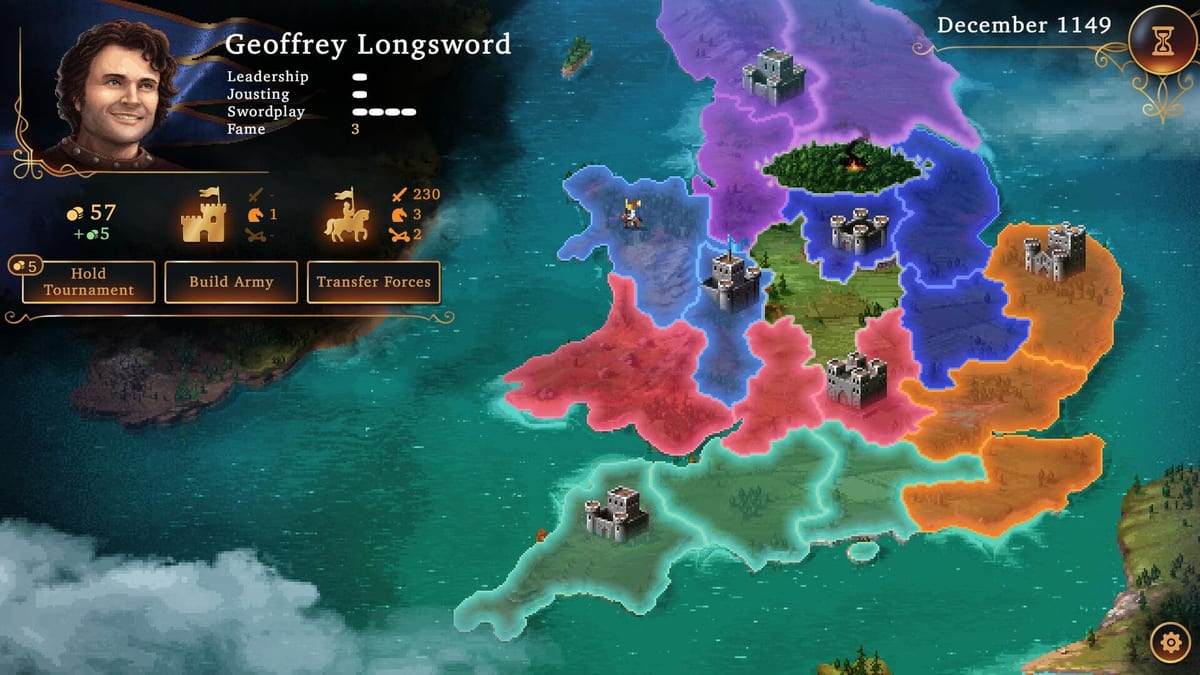
The strategic map is the whole game when nobody is jousting. Defender of the Crown: The Legend Returns paints England and Wales as a board in turquoise water. Classic Mode’s launch HUD is the clearest version: rival territories glow purple, blue, red, orange, green; castles sit as stone icons; a tiny rider marks a stack; an hourglass ends the month; the date reads something like December 1149. This page teaches you to look at that painting. It is not a datamined gazetteer of every shire name the code might hide.
Classic and Retro: the visible board
Colours are owners. Your job is to make more of the island your colour without lighting the Norman fuse early. Castles are the seats that pay. Empty pretty land without a keep is a parade. The HUD’s castle count is the score that matters next to gold. Income listed under the coin is the reason to take a seat instead of a forest.
Roads and travel matter because a month is a month. Transfer Forces exists so a 230-soldier home stack can become a field army without living in the capital forever. Allies in Classic will let you cross during Saxon peace; after the first Norman castle, those roads become other people’s kill boxes. The campaign walkthrough is the political layer. The map is the geometry.
Retro’s pixel southern Britain is the same idea with less HUD. Forests are darker green, mountains are tan teeth, castles are chunky. You will miss the coin prediction. You will not miss the fact that water is a wall. Plan coasts as borders, not as scenery.
Kingdom: a second map on top
Kingdom keeps a familiar outline and then hides it. Fog of war is the actual opponent for the first hour. Other powers help reveal. Your primary rival waits behind mist you have not paid to clear. Points of interest — tournaments, ladies, raids, heart shops — spawn and then can expire as months pass. Walking every tile is not completion. It is how a calendar steals the good ones. See Kingdom Mode for the timer. See this page for the habit: reveal toward the lord, not toward the pretty tree.
Sherwood and story tiles
A darkened map can still pop a story frame. Sherwood Forest is one: Robin of Locksley by a fire, three pledges of aid, a reminder that the realm is your problem now. Treat story tiles as buttons with costs. They spend a visit. They do not spend a siege. Do not clear a narrative camp instead of a catapult shop and then call the map unfair.
How to use the map in a real month
- Read your colour, your castle count, and your three piles before you click a verb.
- Trace the path to the next keep you actually want. Count the months.
- In Classic, ask whether that keep is Norman and whether you are ready for peace to die.
- In Kingdom, ask whether the fogged tile is on the way to the rival or a tourist trap.
- Then open How to Siege if the destination is a wall.
The map is handsome. The hourglass is not. Play the hourglass. England is small enough that a wasted month is a visible stain, and that is the whole pleasure of a board you can see.
Frequently Asked Questions
Quick answers drawn from official notes and launch play.
Are the coloured regions different modes?
No. Colours are owners on the strategic board. Modes change rules, not the idea of a painted England.
Why can’t I walk somewhere in Kingdom?
Fog of war hides tiles until you reveal them. Other lords and fights help open the map.
Does the date matter?
Yes. Kingdom events can expire. Classic’s date is the campaign clock that ends Saxon peace after a Norman keep falls.
Is there a full province list?
Not as a public official table. Use the HUD: castles, income, and colours beat a fan-made spreadsheet.